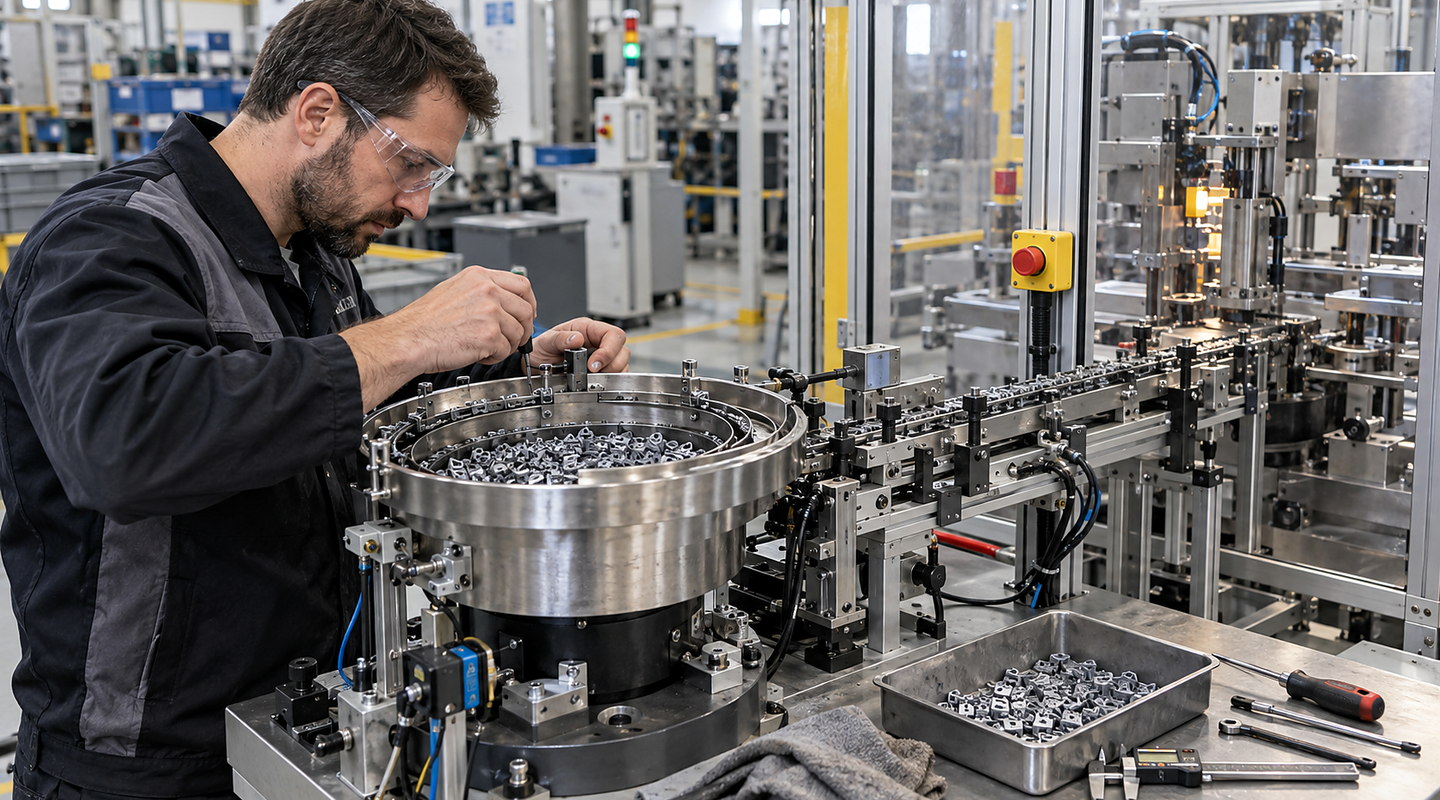
Feeder Tracks and Presentation Tooling: How the Process Works
Plan feeder-track trials from the receiving-tool datum through component variation, track transitions, accumulation, single-part release and interrupted-transfer recovery.
Define the final component face, axis and position required by the receiving tool, then work back through the escapement, track and transitions. Use parts spanning normal dimensional, finish, lubrication and supplier variation. Trial a full track, drain-down, no demand, a blocked destination and interrupted transfer while checking usable delivery and component condition.
Prepare the track and receiving-tool checklist and component-variation brief. A component travelling to the end of a rail is not an accepted delivery if it cannot be picked in the agreed position.
Understand the complete route from input to accepted output — Feeder Tracks and Presentation Tooling
Plan feeder tracks and presentation tooling around real component variation, bulk condition, orientation, usable delivery rate and the downstream interface. Discuss representative part trials with Sorting Solutions. Follow the material or part through each operating step and include recovery, cleaning and change in the real cycle.
Discuss your application

Four clear stages for feeder tracks and presentation tooling
At each stage, you can review how component geometry and variation for feeder tracks & presentation tooling and jam, damage and recovery acceptance checks affect the next commitment.
- 01
Review Representative Production Components
Provide drawings and production-condition components spanning normal tolerances, finish, lubrication and supplier variations. Identify permitted support features, surfaces that must not be marked and the receiving-tool datum.
- 02
Trial Separation, Orientation and Presentation
Trial transitions from the feeding source through each track section to the escapement. Compare full and nearly empty conditions, checking orientation, overlap, wedging and the final presented component.
- 03
Develop Tooling, Controls and the Downstream Interface
Define the required face, axis and position, receiving-tool envelope, buffer and part-present sensing. Agree single-part release and the handover when demand stops or the destination is blocked.
- 04
Challenge Delivery, Replenishment, Jams and Recovery
Challenge full-track restart, drain-down and interrupted transfer using the agreed component range. Record usable delivery, final position, damage, jams and recovery, with the correct settings and change parts identified.
Decisions and results stay connected
| Stage | What happens | What you can review |
|---|---|---|
| Review Representative Production Components | Provide drawings and production-condition components spanning normal tolerances, finish, lubrication and supplier variations. Identify permitted support features, surfaces that must not be marked and the receiving-tool datum. | Identified drawings, component samples, contact limits and receiving-tool datum. |
| Trial Separation, Orientation and Presentation | Trial transitions from the feeding source through each track section to the escapement. Compare full and nearly empty conditions, checking orientation, overlap, wedging and the final presented component. | Observed transitions, track fill state, orientation and component-condition results. |
| Develop Tooling, Controls and the Downstream Interface | Define the required face, axis and position, receiving-tool envelope, buffer and part-present sensing. Agree single-part release and the handover when demand stops or the destination is blocked. | Agreed pick envelope, buffer, single-release and stop/recovery handovers. |
| Challenge Delivery, Replenishment, Jams and Recovery | Challenge full-track restart, drain-down and interrupted transfer using the agreed component range. Record usable delivery, final position, damage, jams and recovery, with the correct settings and change parts identified. | Accepted-delivery, jam/damage and recovery records tied to the actual tooling setup. |
Keep connected responsibilities clear
Your final feeder tracks and presentation tooling scope must also account for escapement and downstream pick interface, jam, damage and recovery acceptance checks, current regulations and the conditions at your site.
- Sample trials must include normal, marginal and supplier-variant components.
- Quoted feeder output is not the same as usable delivery at the downstream process.
- Fragile, flexible, magnetic or entangling parts may need a different presentation method.